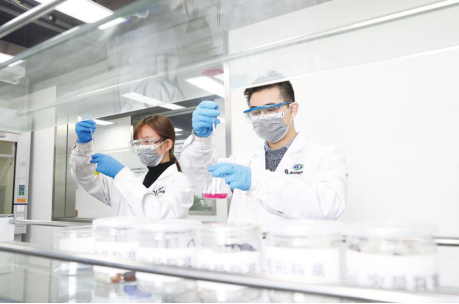
The research team of Researcher Wen Xiaodong from the Institute of Coal Chemistry, Chinese Academy of Sciences (ICC-CAS), in collaboration with the team of Professor Ma Ding from Peking University, published a paper in the journal Science, achieving for the first time in iron-based Fischer-Tropsch synthesis (FTS) catalysts a major breakthrough with CO₂ selectivity below 1% and olefin selectivity exceeding 85%. This achievement provides a completely new approach for the clean and efficient utilization of high-carbon resources, helping to reduce the deep dependence of industrial olefins on petroleum cracking.
Fischer-Tropsch synthesis is a core process for converting coal, natural gas, biomass, and other feedstocks into liquid fuels and high-value chemicals, with the industry having long relied on iron-based catalysts. In conventional processes, side reactions result in CO₂ selectivity as high as approximately 30%, leading to low carbon atom utilization and high carbon emission pressures, while olefin selectivity is only 20%–30%, becoming a bottleneck constraining the industry's green upgrading.
After years of dedicated research, the joint team proposed an innovative ppm-level trace halogen regulation strategy: by adding only parts-per-million concentrations of haloalkanes (such as CH₃Br) to the syngas, they can precisely regulate the reaction pathways on the catalyst surface, suppressing both the water-gas shift (WGS) reaction and the Boudouard side reaction, nearly completely inhibiting CO₂ formation, while also suppressing olefin hydrogenation side reactions and significantly increasing the yield of high-value olefins.
Key performance data include:
CO₂ Selectivity: Reduced from approximately 30% to <1%, achieving near-zero emissions;
Olefin Selectivity: Increased to >85%, with an olefin/paraffin ratio of approximately 13;
Engineering-Friendly: No changes to catalyst formulation or equipment modifications required, directly adaptable to existing industrial iron-based FTS production lines.
Researcher Wen Xiaodong stated that this technology is like installing a "molecular switch" on the reaction, enabling precise regulation of the reaction network at minimal cost, significantly improving carbon efficiency and economic viability. Professor Ma Ding pointed out that this achievement breaks the technical barrier that made it difficult to achieve both high olefin yield and low carbon emissions simultaneously, opening up a completely new pathway for the efficient and clean utilization of carbon resources.
The achievement has passed a 450-hour continuous stability test with stable performance, demonstrating potential for industrial scale-up. The team is currently advancing pilot-scale validation and industrial demonstration, accelerating the deployment of this technology in coal-to-olefins, syngas-to-fuels, and low-carbon chemical applications, supporting the national "dual carbon" goals and the high-quality development of the energy and chemical industry.