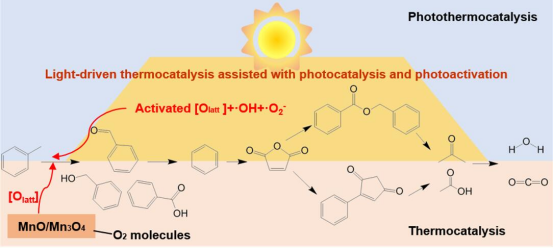
With the rapid development of urbanization and industrialization, the energy crisis and environmental pollution caused by increasing energy consumption and pollutant emissions have become urgent issues to be addressed. Among them, anthropogenic emissions of volatile organic compounds (VOCs) not only pose a direct threat to the environment and human health, but also serve as important precursors for the formation of ozone and fine particulate matter. Catalytic oxidation can efficiently remove VOCs at low temperatures; however, for pollutants containing benzene rings such as toluene, the ring-opening process requires high energy and still needs external electrical heating to achieve complete degradation of pollutants. Photocatalysis converts light energy into chemical energy based on photocatalysts to drive catalytic oxidation reactions of pollutants, but this process generally suffers from low quantum efficiency and easy recombination of photogenerated charge carriers. Photothermal catalysis uses full-spectrum light to supply energy for catalytic reactions, utilizing the photoeffects of high-energy UV-visible light and the thermal effects of infrared light to drive catalytic oxidation reactions, combining the energy-saving and high-efficiency advantages of both photocatalysis and thermal catalysis. The core lies in the design and synthesis of photothermal catalysts and the elucidation of photothermal catalytic reaction mechanisms.
China's first thousand-ton-level VOCs degradation project employing a novel nano-titanium dioxide photocatalyst has been officially commissioned in an industrial park in Jiangsu Province. The project utilizes sunlight and low-energy LED light sources to excite the catalyst, enabling the complete decomposition of toxic and hazardous VOCs into water and carbon dioxide at room temperature, with a treatment efficiency exceeding 95%.