A research team led by Professor Shi Jianwen from the School of Electrical Engineering at Xi'an Jiaotong University has successfully developed a bifunctional electrocatalyst for seawater electrolysis. The study breaks through the bottleneck of balancing activity and stability in seawater electrolysis catalysts, elucidates the regulatory mechanism of interfacial bonding, and provides new insights for the development of efficient bifunctional electrocatalysts in complex electrolyte environments. The findings were recently published in the journal Nano Energy.
Seawater is the most abundant water resource on Earth. Direct electrolysis of seawater for hydrogen production eliminates reliance on precious freshwater resources and avoids the energy-intensive desalination process, offering significant economic and resource advantages and considered an ideal pathway for large-scale hydrogen production in the future. However, seawater electrolysis catalysts still face multiple bottlenecks in practical applications. The complex ionic composition of seawater can cause electrode corrosion, poisoning of catalytic active sites, and competition from chlorine evolution reactions, while simultaneously achieving stability under alkaline conditions and bifunctional catalytic efficiency remains a persistent challenge. The design and development of electrocatalysts with ultra-high bifunctional activity, long-term stability, and corrosion resistance is of great significance for promoting the development of the green hydrogen industry.
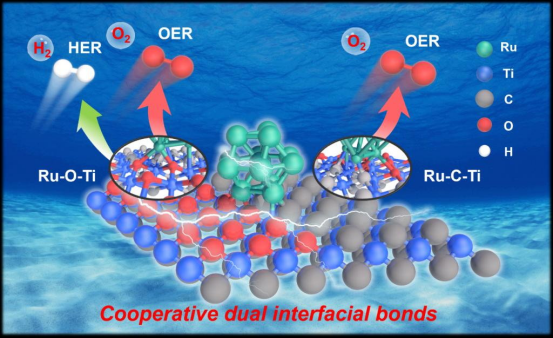
The novel catalyst developed by the research team uses nickel foam as a substrate, anchoring ultra-low-loading ruthenium clusters onto the surface of titanium carbide oxide (Ti₃C₂Oₓ) nanosheets through precise electrodeposition technology, forming a composite structure with tightly integrated "active sites–conductive framework." This design endows the catalyst with both excellent electrocatalytic activity and superior structural stability. Its outstanding performance stems from unique interfacial bonding: the oxygen and carbon terminals of Ti₃C₂Oₓ form Ru–O–Ti and Ru–C–Ti bonds with ruthenium clusters, respectively. These two bonds synergistically guide the directional redistribution of interfacial charge, optimizing the adsorption capacity of reaction intermediates while accelerating the kinetics of both hydrogen and oxygen evolution reactions.
The Xi'an Jiaotong University team innovatively designed a three-dimensional composite catalytic structure: using nickel foam as the conductive substrate, ultra-low-loading ruthenium clusters were anchored onto the surface of titanium carbide oxide (Ti₃C₂Oₓ) nanosheets via precise electrodeposition, forming a tightly coupled "active site–conductive framework" system. Benefiting from the synergistic effects of Ru–O–Ti and Ru–C–Ti interfacial bonds, the catalyst achieves rapid charge transfer and precise regulation of reaction pathways, while significantly enhancing corrosion resistance and resistance to chloride ion interference.
Test data show that the catalyst exhibits excellent performance in alkaline seawater environments:
Hydrogen Evolution Reaction (HER): Overpotential of only 33 mV at 10 mA cm⁻², outperforming commercial platinum-carbon catalysts;
Oxygen Evolution Reaction (OER): Overpotential of 233 mV at 10 mA cm⁻², matching the performance of commercial ruthenium oxide;
Overall Water Splitting Voltage: 1.52 V to drive stable operation at 10 mA cm⁻², with no significant performance degradation during long-term operation;
Engineering Advantages: Extremely low precious metal loading, scalable preparation process, compatible with existing electrolyzer upgrades.
The team stated that this achievement addresses the "high activity, long lifespan, and low cost" triangle dilemma in seawater electrolysis from the perspectives of material design and interfacial regulation. This technology can be applied not only to offshore green hydrogen production but also coupled with renewable energy sources such as offshore wind power and photovoltaics, promoting integrated development of marine clean energy.
Currently, the research team is advancing pilot-scale validation and device integration optimization of the catalyst, accelerating progress toward industrial demonstration and supporting cost reduction and efficiency improvement in China's green hydrogen industry, as well as the efficient utilization of marine resources.