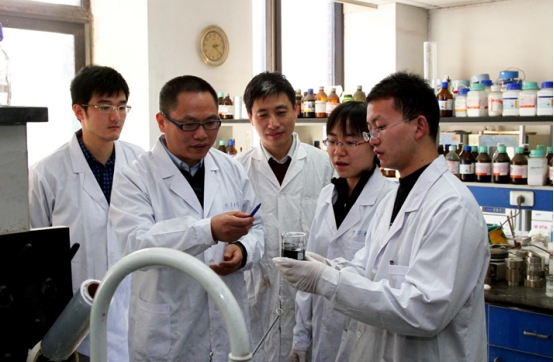
The chemistry department team at Tsinghua University has developed a universal thermal shock synthesis process, successfully scaling up the preparation of single-atom catalysts from milligram-level laboratory batches to kilogram-level mass production. These catalysts have demonstrated near 100% atom utilization efficiency in fine chemical hydrogenation reactions, significantly reducing the cost of precious metal usage.
The concept of single-atom catalysis has been proposed for many years, but systematic progress had been lacking, primarily due to the absence of a simple and feasible synthetic method. Over the past decade of research, Academician Li Yadong, building on decades of accumulated experience in nanomaterial synthesis, led his team to systematically develop designable, controllable, and universal synthetic methods for single-atom catalysts. These methods enabled the large-scale synthesis of single-atom catalysts with high metal loadings and uniform microstructures, and the team also developed a toolbox of single-atom catalysts using these approaches. After tens of thousands of experiments, they have successfully converted nearly all catalytically important elements in the periodic table into single-atom catalysts. To date, this toolbox has been largely perfected, containing hundreds of single-atom catalysts.
"If discovering single-atom catalysts and conducting experimental validation was the first step we took in the field of single-atom catalysis, then developing synthetic methods and building the toolbox was the second step. Now, we are taking the third step—achieving large-scale industrial applications of single-atom catalysts," said Academician Li Yadong.
As Academician Li noted, single-atom catalysts have already demonstrated excellent performance at the laboratory stage, and the early and mid-phases of single-atom catalysis have been largely completed. Collaborating with the industrial sector to promote the industrial application of these catalysts has become an urgent priority. "Our Chinese medicine pharmacy is now well-stocked. Now it's time to prescribe the right remedies for different symptoms," he humorously remarked.
Academician Li gave an example: "For instance, the exhaust purification catalysts used in current fuel-powered vehicles are mostly nanocatalysts. If we adopt single-atom catalysis technology, we could significantly reduce costs and more effectively cut pollutant emissions."
So, how far are we from large-scale industrialization of single-atom catalysis? "One could say that the prologue to the industrialization of single-atom catalysis has already begun. The automotive exhaust catalysts and lubricating oil hydrogenation catalysts I mentioned are currently undergoing pilot trials. If all goes well, we may be able to conduct technology appraisals by the end of this year and further establish scaled-up demonstration units. Optimistically, in the next two to three years, large-scale industrialization of single-atom catalysis in relevant fields could be realized."
"But we must also clearly recognize that despite the significant progress in single-atom catalyst research, technical challenges remain, including catalyst stability, scaled production, and cost-effectiveness," added Academician Li.
At the end of the interview, Academician Li told the reporter: "The discovery and synthesis of single-atom catalysts give us the confidence and hope to challenge the limits of materials science, striving to achieve atomically precise manufacturing. Once the industrial demonstration of single-atom catalysis technology succeeds, humanity may have the opportunity to enter a new era—from the micro-nano scale to the single-atom, single-molecule scale. We hope this technology can benefit humanity and bring new blessings to both academia and industry."